The Lean Startup by Eric Ries: Learn Startup English with Fluently app
If you want to improve your English and also learn modern startup thinking, this book is a smart pick. It uses real business language, clear examples, and repeated key terms that help you remember new words.
About the Book
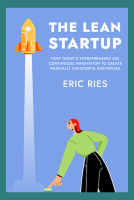 Title: The Lean Startup
Author: Eric Ries
Genre: Business
Year of Publication: 2011
Pages: 336 pages (page count can vary a little by edition)
Summary: What the Book Is About
In The Lean Startup by Eric Ries, you learn a simple way to build new products with less waste and fewer risky guesses. The book explains how startups (and new projects inside big companies) can test ideas step by step, learn from real customers, and change direction when needed. It focuses on experiments, clear metrics, and fast learning, so you do not spend months building something nobody wants.
“A startup is a human institution designed to create a new product or service under conditions of extreme uncertainty.”
Key ideas in The Lean Startup by Eric Ries
The book is famous because it gives a clear system you can copy. You do not need to be a founder to use it. You can apply it to a new team process, a side project, or even a personal plan.
The 5 ideas to remember
-
Start small, learn fast: do not build the “perfect” version first.
-
Use an MVP (minimum viable product): a simple first version that helps you test your idea.
-
Follow Build–Measure–Learn: build a small test, measure results, learn, then improve.
-
Use actionable metrics: numbers that help you decide what to do next (not “vanity” numbers).
-
Pivot when needed: change direction if your tests show the idea is not working.
English Level
-
CEFR level: B2 (strong intermediate)
-
Learners preparing for: IELTS 6.5+ / TOEFL iBT 90+
Why B2? The sentences are usually clear, but the book uses business terms, abstract ideas, and long explanations. If you are B1, you can still read it, but you will need more time and a vocabulary notebook.
Why This Book Helps English Learners
This book is useful because it repeats core concepts in different ways. That means you see the same vocabulary again and again, but in new contexts.
Skills you can develop:
-
Reading: understand business writing and structured arguments
-
Vocabulary: learn startup and management words that appear in US business media
-
Idioms & set phrases: common professional phrases (for example, “build momentum,” “take a risk,” “real-world feedback”)
-
Grammar in context: conditionals (“if… then…”), cause-and-effect (“because… therefore…”), and comparison (“more than,” “less likely,” “the best way to…”)
Estimated unique words: about 10,000–12,000 (this is an estimate; it depends on edition and how you count word forms).
Helpful vocabulary themes you will meet
-
Experiments and testing (test, validate, measure, iterate)
-
Product development (prototype, feature, release, roadmap)
-
Customers and markets (demand, segment, retention, value)
-
Numbers and results (metrics, growth rate, baseline, evidence)
Mini routine: how to read it for language progress
-
Read 5–10 pages a day.
-
Highlight 5 new words (not 50).
-
Write 2 short summary sentences in your own English.
-
Say one key sentence out loud to practice speaking rhythm.
How to study The Lean Startup by Eric Ries with Fluently app
Reading is great, but your English grows faster when you use the words. A simple way is to turn chapter ideas into short speaking practice.
A simple 3-step method
-
Read one small section (2–4 pages).
-
Pick 5 useful words and write your own examples.
-
Speak for 60 seconds: explain the idea like you are teaching a friend.
You can do this inside Fluently app by practicing short explanations and repeating the same message with clearer words each time.
Key terms + simple practice sentences
| Term | Simple meaning | Easy sentence you can copy |
|---|---|---|
| MVP | the simplest version of a product | “Our MVP is a basic version that tests one idea.” |
| Pivot | change direction based on learning | “We pivoted after feedback showed a different need.” |
| Metrics | numbers that track results | “These metrics tell us if we are improving.” |
| Assumption | a guess you treat like a fact | “That assumption was wrong, so we tested again.” |
| Validation | proof from real users | “We need validation before we build more features.” |
User Reviews
⭐⭐⭐⭐⭐ “It helped me stop guessing and start testing. The examples made the ideas feel real, not theoretical.”
⭐⭐⭐⭐ “Some parts repeat, but that also helped me learn the vocabulary. I now understand ‘pivot’ and ‘metrics’ clearly.”
⭐⭐⭐⭐ “Good for product teams, not only founders. It changed how I think about planning and feedback.”
Average Rating: 4.4 / 5
Did You Know?
-
Eric Ries developed many ideas from his startup work and from “lean” thinking used in manufacturing, then adapted it to modern tech teams.
-
The book helped popularize terms like MVP and the Build–Measure–Learn loop in startup culture.
-
Many companies use “lean startup” ideas not only for new products, but also for testing marketing messages and internal processes.
Similar Books You Might Enjoy
If you like the topic and want more practice with business English, try these:
-
Running Lean — Ash Maurya
-
The Startup Owner’s Manual — Steve Blank and Bob Dorf
-
Zero to One — Peter Thiel (with Blake Masters)
❓ FAQ
Is this book useful if I don’t work in a startup?
Yes. The main ideas are about testing and learning. You can apply them to projects in marketing, education, product teams, or even personal goals.
Should I read it in print, ebook, or audio for English practice?
For vocabulary growth, print or ebook is best because you can highlight and re-read. Audio is great for listening and pronunciation, but it is harder to notice new words.
How can I remember the vocabulary from each chapter?
Choose only 5–8 words per chapter. Write your own sentences. Then explain the chapter in simple English using those words.
What if the business terms feel too difficult?
Do not translate every word. First, understand the main idea of the paragraph. Then learn the few words that repeat many times (like “metrics,” “assumption,” “validation”).
How long does it take to finish the book with steady progress?
If you read 10 pages a day, you can finish in about 4–5 weeks. If you add short speaking practice, your progress will feel faster even with fewer pages.
To practice speaking after reading, open Fluently app and record a 60-second explanation of one concept (MVP, pivot, or metrics).